

Top-tier enterprises understand a hard financial truth: businesses rarely collapse from a lack of profitability; they fail because they run out of liquid cash. Securing strategic financing allows business owners to maintain aggressive margins, fund daily operations, and execute market opportunities without waiting for internal revenue to clear the bank.
For growing startups and established mid-market companies alike, deploying short-term financial facilities acts as a highly effective treasury management tool when backed by rigorous mathematical planning. This analysis breaks down the mechanics, strategic advantages, and strict risk-management protocols required before injecting external capital into your operational pipeline.
Defining the Baseline: Apa Itu KMK and Why It Dictates Survival
In regional financial markets, founders frequently ask apa itu kmk before realizing its universal application across global finance. At its core, this facility is engineered specifically to fund daily, short-term operational liabilities.
Rather than funding long-term assets like real estate or heavy machinery, understanding that kredit modal kerja adalah exactly what modern enterprises need to bridge the friction gap between accounts payable and accounts receivable is critical. It acts as the financial liquidity keeping the engine running: buying raw materials, paying suppliers, covering payroll, and buffering temporary cash deficits.
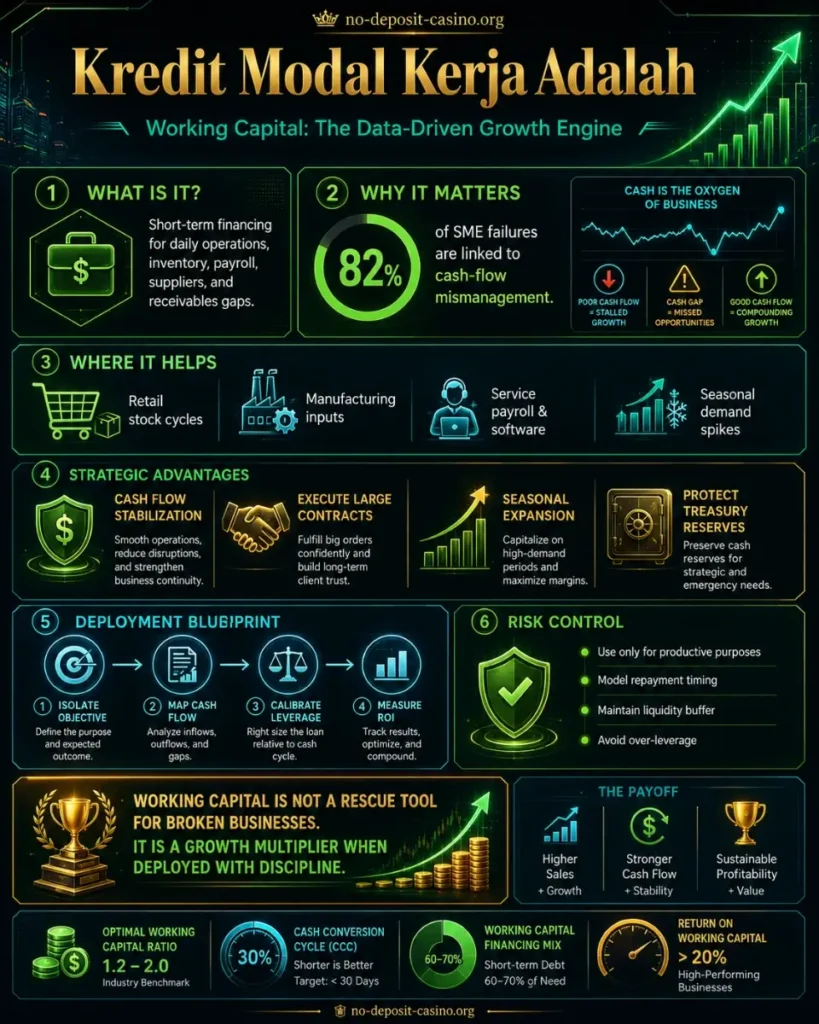
Industry data indicates that up to 82% of small-to-medium enterprise failures stem directly from cash flow mismanagement. A company might showcase a flawless balance sheet with massive sales volume, yet face complete operational paralysis simply because liquid cash is tied up in 60- or 90-day invoice cycles.
The Mechanics of Liquidity: Why Pinjaman Modal Kerja Adalah a Growth Multiplier
Working capital is the raw fuel combusting inside a business engine every single day. Without adequate fuel reserves, companies cannot acquire inventory, distribute products, or maintain service level agreements (SLAs).
In practical application, pinjaman modal kerja adalah the ultimate strategic buffer against operational friction. When a massive client takes eight weeks to pay, but your supply chain demands cash today, a well-structured credit line prevents missed orders, delayed fulfillment, and reputational damage.
The requirement for operational liquidity is cyclical:
- Retail Operators: Constantly require capital to replenish high-turnover stock arrays.
- Manufacturing Sectors: Bleed cash through raw material acquisition, labor, and logistics long before a finished product hits the shelf.
- Service-Based Firms: Carry heavy fixed costs—salaries, leases, software infrastructure, and marketing output.
Strategic Advantages: Proving Why Kredit Modal Kerja Adalah the Ultimate Buffer
Short-term financing delivers the highest Return on Investment (ROI) when injected directly into revenue-generating operations. Here is a breakdown of the structural advantages savvy operators exploit when deploying this capital:
1. Aggressive Cash Flow Stabilization
Credit lines close the dangerous gap between outgoing operational expenses and incoming client payments, effectively neutralizing the threat of late-paying accounts.
2. Executing High-Volume Contracts
When a massive purchase order lands, companies require immediate liquidity to scale raw materials and labor. Short-term facilities allow operators to seize these heavy-weight contracts without draining their primary treasury reserves.
3. Capitalizing on Seasonal Surges
Markets experience violent seasonal fluctuations. Credit facilities allow businesses to front-load their operational capacity weeks before the actual revenue hits the ledger, ensuring warehouses remain fully loaded precisely when demand spikes hit the market.
Looking to exploit high-RTP algorithms without risking your own bankroll? Explore our complete database of verified promotions, strategic guides, and exclusive sign-up bonuses at the ultimate Free Credit No Deposit Casino Hub.
Deploying Modal Kredit to Engineer Aggressive Scaling
To extract genuine ROI from financing, operators must enforce extreme financial discipline. Strategic modal kredit should only be deployed when the funds are strictly productive, the exact allocation is documented, and the anticipated revenue generated mathematically covers the cost of the debt.
- Isolate the Objective: Restrict capital usage strictly to inventory, raw materials, supplier payments, or direct production costs.
- Map the Cash Flow Trajectory: Build a realistic projection of all cash entering and exiting the business during the lifecycle of the loan. Ensure the company maintains a sufficient liquidity buffer to service the debt.
- Calibrate the Leverage: Over-leveraging creates suffocating interest burdens, while under-leveraging leaves growth on the table. Pinpoint the exact financial requirement.
Short-term financing is not a magic fix for fundamentally flawed business models. But when engineered correctly, it operates as a high-octane growth multiplier, allowing ambitious enterprises to scale with speed and precision.
Responsible Financial Management & Gambling: Whether managing corporate cash flow, navigating financial markets, or playing high-RTP casino games, financial discipline is non-negotiable. Both business leverage and gambling involve inherent financial risk. Our analytical guides are provided strictly for informational purposes and do not guarantee profit. Please manage your bankroll responsibly, enforce strict liquidity limits, and never risk funds you cannot afford to lose. If you or someone you know is experiencing a gambling problem or overwhelming financial distress, please seek professional help immediately. 18+ Only.
What exactly does a working capital facility do?
It is a short-term financing facility designed strictly to fund daily operational liabilities—such as payroll, supplier invoices, and inventory acquisition—ensuring your business remains liquid during cash flow gaps.
How does short-term credit stabilize corporate cash flow?
It acts as a strategic buffer that bridges the friction gap between accounts payable (money you owe immediately) and accounts receivable (money clients owe you in 30 to 90 days).
When is the right time to leverage this type of business financing?
You should deploy this credit when market demand aggressively outpaces your organic liquidity, when securing massive purchase orders, or when preparing for high-volume seasonal sales spikes.
Can I use operational funding for long-term physical assets?
No. Utilizing short-term operational liquidity to purchase illiquid, long-term assets (like real estate or heavy machinery) creates a dangerous mismatch on your balance sheet and restricts your daily cash flow.
How do I calculate the exact amount of funding required?
Execute a hard financial model comparing your upcoming 90-day operational expenses against your projected invoice clearances. Only borrow the exact delta needed to sustain operations and fulfill orders.